
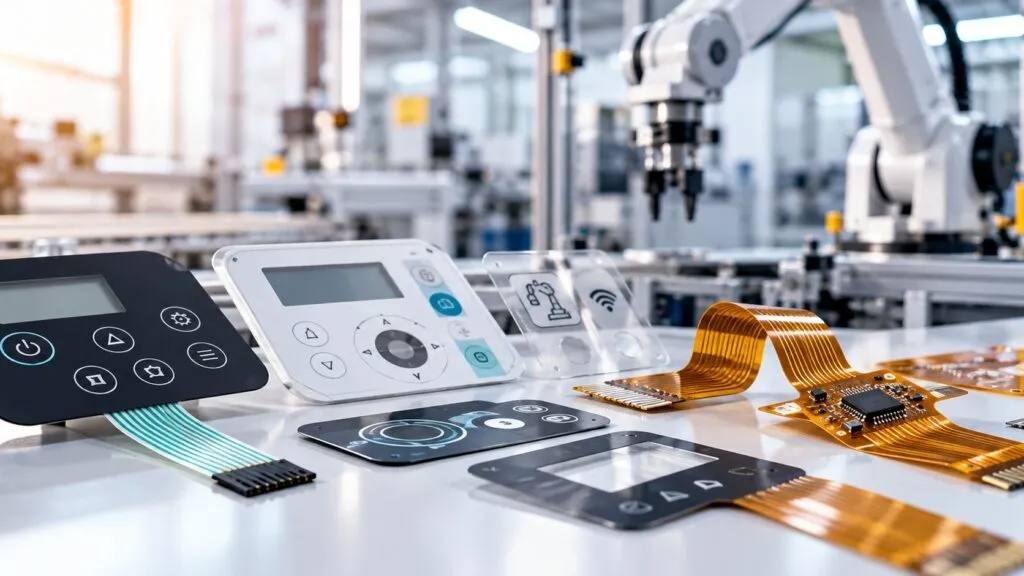
Robotic manufacturing cells look like they run on motors and motion controllers, but the parts an operator actually touches, and the connections that keep a robot’s sensors talking to its controller, are usually printed electronics. Membrane switches, graphic overlays, and flexible printed circuits sit at the physical interface between a robot and the people who operate, teach, and maintain it.
As Malaysia’s electrical and electronics (E&E) manufacturing corridor adds more robotic and automated lines, the printed electronics behind that equipment matter more than most buyers realise.
A robotic work cell is only as reliable as its weakest interface component. The robot arm itself is usually a proven, off-the-shelf mechanism, but the control panel, teach pendant, and the wiring that runs through the arm’s joints are typically built or specified separately, and they’re exposed to conditions the arm’s core mechanics never see: repeated flexing, factory dust and oils, washdown cycles, and constant operator contact.
Printed electronics, membrane switches, graphic overlays, and flexible circuits, are built specifically to survive that environment while staying thin, lightweight, and cost-effective compared with mechanical switches or rigid PCB assemblies in the same locations.
A teach pendant is the handheld device an operator uses to jog, program, and troubleshoot a robot, and it typically relies on a membrane keypad rather than mechanical buttons. Membrane switches are sealed, which protects the internal circuitry from dust, coolant, and handling oils on a factory floor, and they have no moving mechanical parts to wear out under the thousands of presses a teach pendant sees over its service life.
The same logic applies to fixed control panels on the robot cell itself, where operators need tactile, reliable inputs for start, stop, and mode-select functions that have to work consistently shift after shift.
Design details that matter for this application include tactile feedback (so an operator can confirm a press without looking at the panel), embossed or domed keys for function identification by touch, and sealing ratings appropriate to the cell’s environment.
The graphic overlay is the visible face of a control panel or HMI, the layer with printed labels, icons, logos, and (where needed) windows for LED indicators or display cutouts, bonded over the membrane switch layer underneath.
For robotic manufacturing equipment, overlays need to combine clear visual communication (so an operator can identify a function at a glance, which matters for safety-critical stop and reset controls) with physical durability: resistance to abrasion from repeated touch, UV stability if the cell is near windows or outdoor-adjacent areas, and chemical resistance to the solvents and lubricants common on a manufacturing line.
Embossed overlays, where key areas are raised to give tactile location cues, are common on robot control panels specifically because operators often need to locate the emergency stop or mode-select function without looking away from the robot’s work envelope.
Inside a robotic arm, wiring has to survive a motion profile that rigid circuit boards and standard cabling were never designed for: repeated bending at every joint, millions of flex cycles over the arm’s service life, and tight routing through narrow internal channels. Flexible printed circuits (FPCs) are built on a bendable substrate specifically to handle this kind of dynamic flexing without the conductor fatigue and cracking that eventually affects rigid wiring harnesses in the same application.
FPCs in robotics applications typically carry power to end-effectors and tooling, and signal lines for position encoders, force/torque sensors, and vision or proximity sensors mounted near the wrist or gripper. This is why FPC routing has become a standard design choice for articulated and collaborative robot arms rather than a specialty option.
Because routing and connector placement are specific to each robot model, this is typically discussed directly with a fabrication partner at the design stage rather than sourced as a standard part.
Malaysia’s electrical and electronics manufacturing base, concentrated around Penang and the Klang Valley, is a genuine driver of demand for robotic and automated production lines, which in turn drives demand for the printed electronics that go into them.
Penang in particular has positioned itself around this shift: AUTOMEX Penang 2025, a dedicated robotics and industrial automation trade event held in November 2025, was framed explicitly around the state’s Industry 5.0 ambitions, with officials describing a plan to prepare 150,000 workers by 2030 for higher-value automation, design, and advanced-packaging roles.
At the national policy level, Malaysia’s New Industrial Master Plan 2030 includes a dedicated sectoral chapter on the electrical and electronics industry, covering the government’s direction for automation adoption, workforce upskilling, and advanced manufacturing competitiveness in this sector. It’s worth treating this as the authoritative policy reference rather than relying solely on third-party market-size estimates.
On market sizing specifically, caution is warranted: estimates for Malaysia’s industrial robotics market vary substantially between research providers, with figures ranging from the low hundreds of millions to close to USD 2 billion depending on the source and methodology. These are directional market-research estimates, not verified government statistics, and buyers evaluating this space should treat any single figure as an approximation rather than a precise benchmark.
For more rigorous country-level data, MITI/MIDA’s Industry4WRD publications and the International Federation of Robotics’ (IFR) country statistics are better starting points than any single market-research report.
Robotics and automation projects tend to demand more from a printed electronics supplier than simpler consumer or appliance applications do, for a few concrete reasons. First, tolerance for failure is lower: a membrane switch or FPC failure on a production robot can stop an entire line, not just one device.
Second, these are rarely off-the-shelf parts, teach pendant layouts, overlay graphics, and FPC routing are typically custom to the robot model and the cell’s control architecture, so a supplier needs genuine custom fabrication capability rather than a catalogue of standard parts.
Third, quality certification matters at a different level: ISO 9001:2015 certification for membrane switches and graphic overlays is a reasonable baseline expectation for industrial and robotics applications, given the consistency required across production runs.
Local engineering support is also a practical consideration for Malaysian manufacturers integrating robotics into existing lines: being able to work directly with a supplier on prototype iterations, rather than managing design changes across time zones, shortens the path from concept to a validated production part.
Membrane switches are sealed against dust, oil, and factory-floor contaminants, and they have no mechanical parts to wear out under repeated use, which matters for panels and teach pendants that get pressed thousands of times over their service life.
Durability against abrasion, chemical exposure, and (where relevant) UV exposure, combined with embossed or tactile features that let an operator locate critical controls like emergency stop without looking away from the robot’s work envelope.
Robotic arm joints flex repeatedly over millions of cycles. Flexible printed circuits are built on a bendable substrate designed to withstand this dynamic flexing, where standard rigid wiring or circuit boards would eventually fatigue and fail.
Estimates vary significantly between research providers. Treat any single figure as a directional estimate, and refer to MITI/MIDA Industry4WRD publications or IFR country data for more rigorous country-level figures.
As Malaysia’s E&E manufacturing corridor continues to add robotic and automated production lines, the printed electronics behind each cell, the teach pendant’s membrane keypad, the control panel’s graphic overlay, the flexible circuit routed through the arm, are what keep operators safely and reliably connected to increasingly automated equipment.
Getting this layer right calls for a manufacturing partner with genuine custom fabrication capability, recognised quality certification, and the engineering support to iterate on a design as a robotics project moves from prototype to production.
Get in touch with Scrint’s engineering team to discuss membrane switch, overlay, or flexible circuit requirements for your next robotics or automation project.