
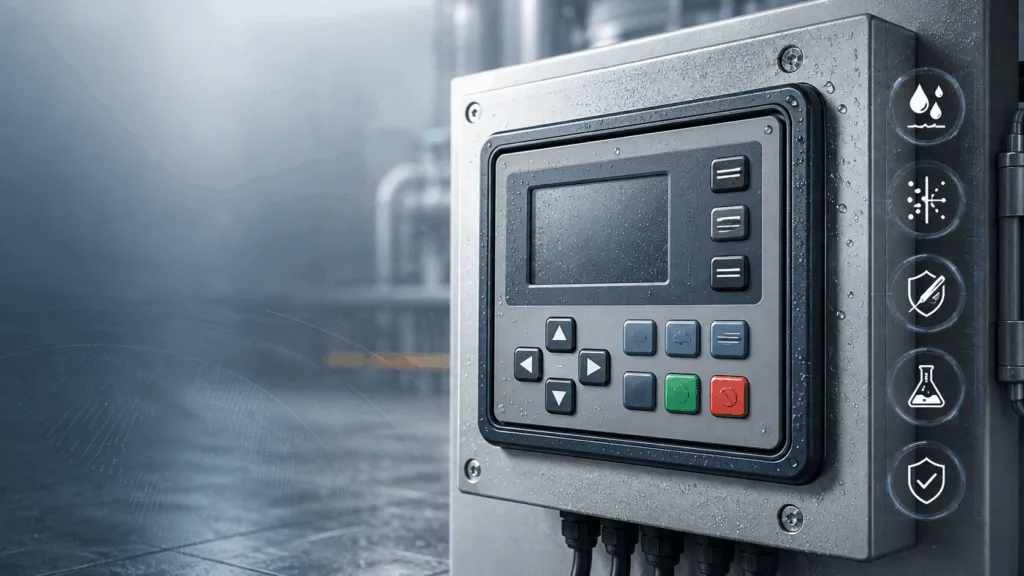
Specifying a membrane keypad for an industrial control panel is a different exercise than choosing one for a home appliance or retail kiosk. On a factory floor, a keypad has to survive vibration, dust, grease, chemical wash-downs, and years of repeated actuation by gloved hands — often without a service technician nearby to replace it. Getting the specification right the first time avoids costly downtime and premature failure in the field.
A membrane keypad is a membrane switch built with labeled, individually defined buttons that together form a full control interface — similar in concept to a calculator or ATM keypad, but engineered for an industrial control panel rather than consumer use. Where a basic membrane switch may serve a single function (a power toggle or mode button), a membrane keypad typically combines multiple switches under one printed graphic overlay, giving operators a complete way to navigate a machine’s functions from one flat, sealed surface.
Because it has no moving mechanical parts, a membrane keypad is inherently more resistant to dust, moisture, and contamination than a traditional pushbutton panel — one of the main reasons it’s specified so widely across industrial equipment.
A membrane keypad on a factory control panel is touched dozens or hundreds of times per shift, often by operators wearing work gloves, and is frequently exposed to oils, solvents, coolant, or wash-down cleaning agents. Unlike a consumer device that might see light use over a couple of years, an industrial keypad is often expected to remain fully functional for the operational lifetime of the machine it’s mounted on — sometimes a decade or more.
A keypad that isn’t specified correctly for its environment doesn’t just look worn — it can fail to register presses reliably, develop cracked graphics that obscure labeling, or let contaminants reach the electronics underneath, leading to unplanned downtime.
When specifying a membrane keypad for an industrial control panel, run through the following before finalizing a design:
| Checklist Item | Why It Matters |
|---|---|
| Hard-coated top surface | Resists scratches, abrasion, and chemical exposure so the graphic layer stays legible under frequent use and cleaning. |
| ESD shielding | Protects both the keypad and the connected control electronics from electrostatic discharge — critical near sensitive machinery controls. |
| Sealed, moisture-resistant construction | Prevents dust, oil, and cleaning fluids from reaching the conductive layers beneath the surface. |
| Tactile response | A noticeable “click” feedback helps operators confirm a press without needing to look down — especially important with gloves on. |
| Embossed or raised key areas | Makes individual buttons easier to locate by touch, reducing mis-presses in low-light or high-glove-thickness environments. |
| Antibacterial surface (where relevant) | Important for shared equipment in food processing, pharmaceutical, or multi-shift environments. |
| Backlighting (SMT LED integration) | Improves visibility and status indication in dim factory areas or 24-hour operations. |
| Actuation life expectancy | Confirm the keypad is rated for the expected press-cycle volume across the equipment’s service life. |
Not every application needs every item on this list — a control panel in a climate-controlled office environment has very different requirements from one on an outdoor generator. The goal is to match the specification to the actual operating conditions rather than defaulting to a standard consumer-grade keypad.
These two terms are often used interchangeably, but they aren’t quite the same thing. A membrane switch is the underlying touch-activated circuit technology; a membrane keypad is a specific application of that technology, built with multiple labeled buttons to form a complete interface. In practice, most industrial control panels use membrane keypads (multiple defined buttons), while simpler equipment may only need a single membrane switch (one control point, such as an on/off toggle).
Membrane keypads are used across a wide range of industrial equipment, including:
Yes, provided the keys are large enough and use embossed (raised) button areas. Pillow or dome embossing in particular gives operators a physical cue they can feel through gloves, reducing mis-presses compared to a flat, non-embossed surface.
Lifespan depends on the specification — surface coating, sealing, and the underlying circuit design all affect actuation life and resistance to the operating environment. The right combination should be matched to the equipment’s expected service life during the design stage, rather than assumed after the fact.
Not necessarily — this depends on the design and how the keypad is mounted. A well-specified keypad with proper sealing and ESD shielding is built to minimize this kind of failure over its rated life, but any wear pattern is worth reviewing against the original specification.
Yes, when specified with the appropriate sealing, hard-coated surface, and chemical-resistant materials. This should be confirmed at the specification stage rather than assumed from a standard indoor-rated keypad.
A membrane keypad is only as durable as its weakest specification choice — sealing, surface coating, ESD protection, and tactile design all need to match the real conditions of the control panel it’s built for. Scrint Technology manufactures custom membrane switches and keypads with hard-coated surfaces, ESD shielding, and embossed tactile options, often paired with a matching graphic overlay for full control panel interfaces. Browse our full product range or contact us to work through the right specification for your equipment.