
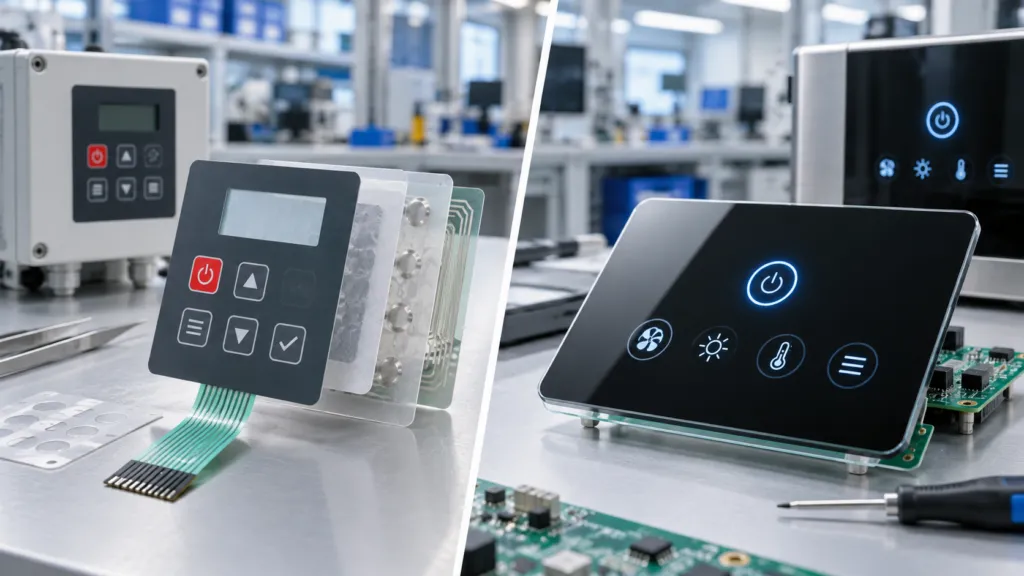
Choosing between a membrane switch and a capacitive switch isn’t just a cost decision, it determines how an interface holds up in its actual operating environment, who can use it, and how consistently it performs over the product’s lifetime.
In short: a membrane switch fits budget-conscious, rugged, or glove-friendly industrial products, while a capacitive switch fits sleek, modern consumer or sealed indoor electronics.
The rest of this guide breaks down exactly why, and where the line between the two isn’t as clean as it first appears.
A membrane switch is a passive device: pressing it physically closes conductive layers to complete a circuit, with no power or control electronics needed to detect the press. A capacitive switch is a solid-state, active device: it continuously monitors for changes in electrical capacitance and requires a microcontroller, programming, and constant power to function at all.
This power-and-setup distinction has practical consequences that go beyond feel, it affects bill-of-materials cost, firmware development time, and even how the product behaves if power is interrupted (a membrane switch’s physical contacts don’t depend on a live controller to register state; a capacitive switch’s touch detection stops entirely without power).
Feature | Membrane Switch | Capacitive Switch |
Operation | Physical pressure closes conductive layers (passive) | Detects changes in electrical capacitance (solid-state, active) |
Tactile feedback | Physical click or snap (metal domes or embossed keys) | None by default — requires added haptics or audio/LED confirmation |
Gloved / tool use | Works with thick work gloves or styluses | Does not register standard gloved touch |
Power & setup | Passive — no constant power or microcontroller needed | Active — requires a microcontroller, programming, and power |
Environment | Resistant to dust, moisture, and EMI/RFI noise (with shielding) | Sealed smooth surface (IP67+), suited to cleanrooms and indoor use |
Cost & volume | Low NRE cost; cost-effective for lower-volume runs (roughly under 25,000 units) | Higher initial NRE and chip cost; scales efficiently at high volume |
For a full breakdown of membrane switch construction, shielding, and material options, see our guide to membrane switch types.
For the complete case for capacitive technology, see our piece on capacitive switch advantages.
Factory floors, heavy machinery, or equipment exposed to dirt, weather, and rough handling benefit from a membrane switch’s dust, moisture, and EMI/RFI resistance.
Necessary wherever operators wear safety gloves or use a stylus, since standard capacitive sensing fails to register these reliably.
A physical click or snap lets an operator confirm an input registered without taking their eyes off the work area, which matters for safety-critical controls.
Without the need for microcontroller programming, membrane switches avoid a layer of NRE cost that makes capacitive switches less economical below roughly 25,000 units.
A strong fit for consumer electronics, glass-front appliances, and smart home devices where a seamless surface is a design priority.
A flush surface with no physical crevices suits medical interfaces, cleanrooms, and food equipment that need frequent sanitising.
A solid-state design has no moving parts to mechanically wear out, which matters for high-cycle-count applications.
Supports swipe, slide, and multi-point gestures that a discrete membrane button layout simply can’t replicate.
For industrial control panels, medical devices operated with gloved hands, and equipment exposed to washdown or variable environmental conditions, membrane switches remain the more predictable and cost-effective choice, especially below higher production volumes.
For consumer-facing products where a sealed, seamless front panel and gesture-based interaction are design priorities, and the operating environment is controlled, capacitive switches are worth the added NRE investment.
Some products combine both: a capacitive area for display or gesture functions alongside membrane-switched keys for critical controls that must work regardless of gloves or moisture, worth discussing directly with a fabrication partner if your product has mixed requirements.
No. A membrane switch is passive, pressing it physically closes a circuit, with no power or control electronics required to register the input. A capacitive switch, by contrast, needs a microcontroller and constant power to sense touch at all.
Standard capacitive switches generally cannot detect touch through non-conductive gloves. Membrane switches work with any glove, or even a stylus, by default.
Roughly under 25,000 units, membrane switches typically avoid the non-recurring engineering cost of microcontroller programming that makes capacitive switches less economical at lower volumes.
Yes, combining a capacitive area for gesture or display functions with membrane-switched keys for critical controls is a common approach for products with mixed requirements.
Neither technology is universally better, the right choice depends on your product’s operating environment, who’s using it, how it needs to be cleaned, and your production volume. If your application involves gloves, styluses, moisture, or lower-volume runs, membrane switches remain the safer default.
If a flush, gesture-capable consumer interface is the priority and volumes are high, capacitive switches justify the added complexity.
Get in touch with Scrint’s team to talk through which technology, or combination, fits your specific product requirements.