
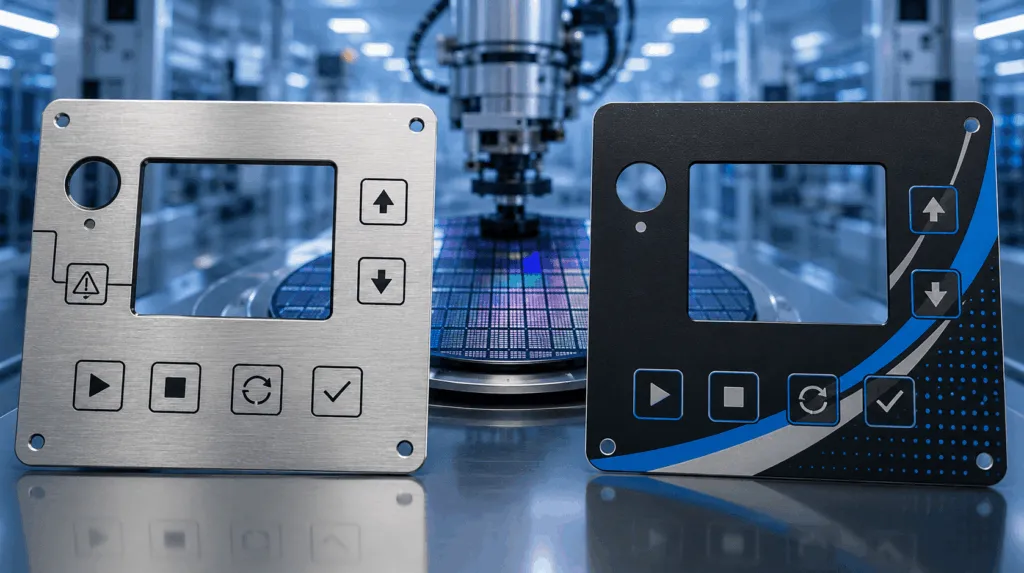
Choosing between a printed metal plate and a plastic graphic overlay membrane isn’t just an aesthetic decision — it affects how your product performs in the field, how long it lasts, and how much it costs to produce at scale. Both materials serve the same basic function (identifying, labeling, and guiding user interaction with a product), but they excel in very different conditions.
Printed metal plates — sometimes called nameplates, rating plates, or data plates — are identification or labeling components made from materials such as aluminium, stainless steel, or brass, with graphics applied through processes like screen printing, digital printing, anodising, or etching. They’re built for permanence: once fixed to a product or piece of equipment, a metal plate is designed to remain legible and intact for the operational life of that equipment, even in demanding conditions.
A graphic overlay membrane is the flexible plastic top layer of a control panel or membrane switch interface, typically manufactured from polycarbonate, polyester, or PVC. Unlike a rigid metal plate, the overlay membrane is thin and pliable, allowing it to integrate directly with the electronics beneath it — supporting features like embossed tactile buttons, backlit icons, and printed branding that sits flush with the interface surface.
Factor | Printed Metal Plates | Plastic Graphic Overlay Membrane |
Heat resistance | Excellent — some metals tolerate up to ~500°C | Good — select high-temp plastics tolerate up to ~388°C |
Chemical/abrasion resistance | Very high; sub-surface printing is essentially permanent | High when properly specified, though generally lower ceiling than metal |
Weight | Heavier; adds load to the product | Lightweight; ideal for portable or weight-sensitive devices |
Design flexibility | Limited to engraving, etching, or surface printing | High — supports embossing, backlighting, curved surfaces, and full-color digital printing |
Tactile/interactive features | Not practical for buttons or switches | Fully compatible with membrane switches, embossed buttons, and dome arrays |
Upfront cost | Higher, due to material and engraving/etching processes | Lower, especially at production volume |
Typical applications | Heavy equipment, aerospace, automotive, marine, outdoor signage | Control panels, medical devices, consumer electronics, appliances |
Metal plates are the right call when permanence and environmental resistance outweigh the need for interactivity or design flexibility. Specific scenarios where metal is generally the better specification include:
The trade-off is cost and weight: metal plates carry a higher upfront cost due to material and engraving/etching processes, and they add weight that plastic overlays avoid.
A graphic overlay membrane is generally the better choice when the product needs an interactive, cost-efficient, or design-flexible interface:
For many products, the choice isn’t strictly either/or. A common and effective approach pairs a metal nameplate — carrying serial numbers, compliance markings, or company branding on the exterior housing — with a plastic graphic overlay membrane for the interactive control panel itself.
This combines the permanence and regulatory compliance benefits of metal where identification matters most, with the tactile and cost advantages of a plastic overlay where user interaction happens.
In extreme heat, heavy chemical exposure, or long-term outdoor use, yes — metal plates generally outperform plastic. However, modern high-performance plastics with the right material and adhesive combination can match or exceed metal durability for many indoor and moderate-environment applications, often at a lower cost.
Not directly — the two serve different structural purposes. A metal plate is rigid and static; a graphic overlay membrane is flexible and built to integrate with switching electronics. Products needing both typically use a metal nameplate for fixed identification alongside a separate plastic overlay for the interactive panel.
Plastic graphic overlay membranes are generally more cost-effective at volume, since metal plates carry higher per-unit costs from engraving, etching, or anodising processes.
Yes, provided the material, coating, and adhesive are correctly specified for UV and weather exposure — but for continuous extreme heat or heavy-duty outdoor equipment, metal plates still offer the higher performance ceiling.
There’s no universally “better” option between printed metal plates and plastic graphic overlay membranes — the right specification depends on your product’s operating environment, interface requirements, budget, and production volume. Metal plates win on permanence and extreme-condition durability; graphic overlay membranes win on design flexibility, tactile functionality, and cost efficiency at scale.
Scrint Technology manufactures both graphic overlay membranes and printed metal plates, alongside membrane switches and dome arrays, for industrial, medical, and consumer electronics applications. If you’re weighing metal versus plastic for your next project, browse our full product range or contact us to discuss the right specification.